
Sprint Retrospective Template
A ready-to-use sprint retro board for Scrum teams. Three columns, real prompts, action items with owners. Open it in your browser, share the link, run the retro in 45 minutes. Free, no sign-up, no participant cap.
The template
Three columns, three questions, one outcome: a short list of changes the team commits to before the next sprint. Cards stay private during silent writing, the board reveals everything at once, and the actions get a named owner and a date.
What went well
Wins worth keeping. Be specific - "good teamwork" is noise.
What didn't
Where the sprint slowed down, broke, or felt heavier than it should.
Action items
Owned next steps with a name and a date. Pick one, not five.
When to use this template
The 3-column sprint retro is the right default when:
- You're closing a normal 1, 2, or 3-week sprint and want a routine cadence.
- The team is new to retros and needs a low-friction starting point.
- You have 45 to 60 minutes and want concrete actions by the end.
- Stakeholders, new hires, and managers all need to read the output at a glance.
Swap it out when the sprint context calls for something sharper - see variants below.
How to run a sprint retrospective with this template
- Setup (5 min). Open the template, name the board after the sprint (Sprint 47 - auth migration), and drop the link in the team chat. Anyone joins without an account.
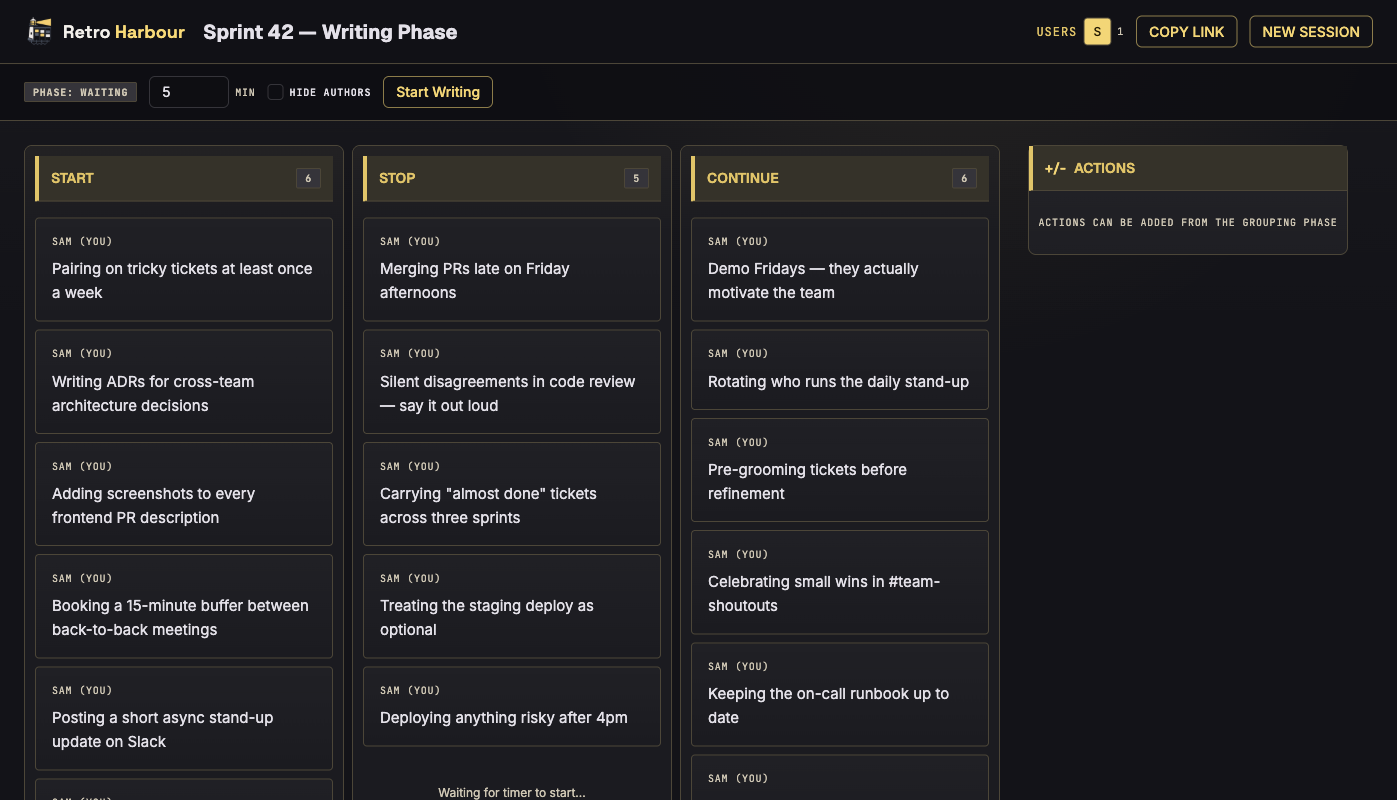
- Silent writing (10 min). Everyone adds cards to What went well and What didn't. Cards stay masked so people commit to honest answers instead of socially safe ones.
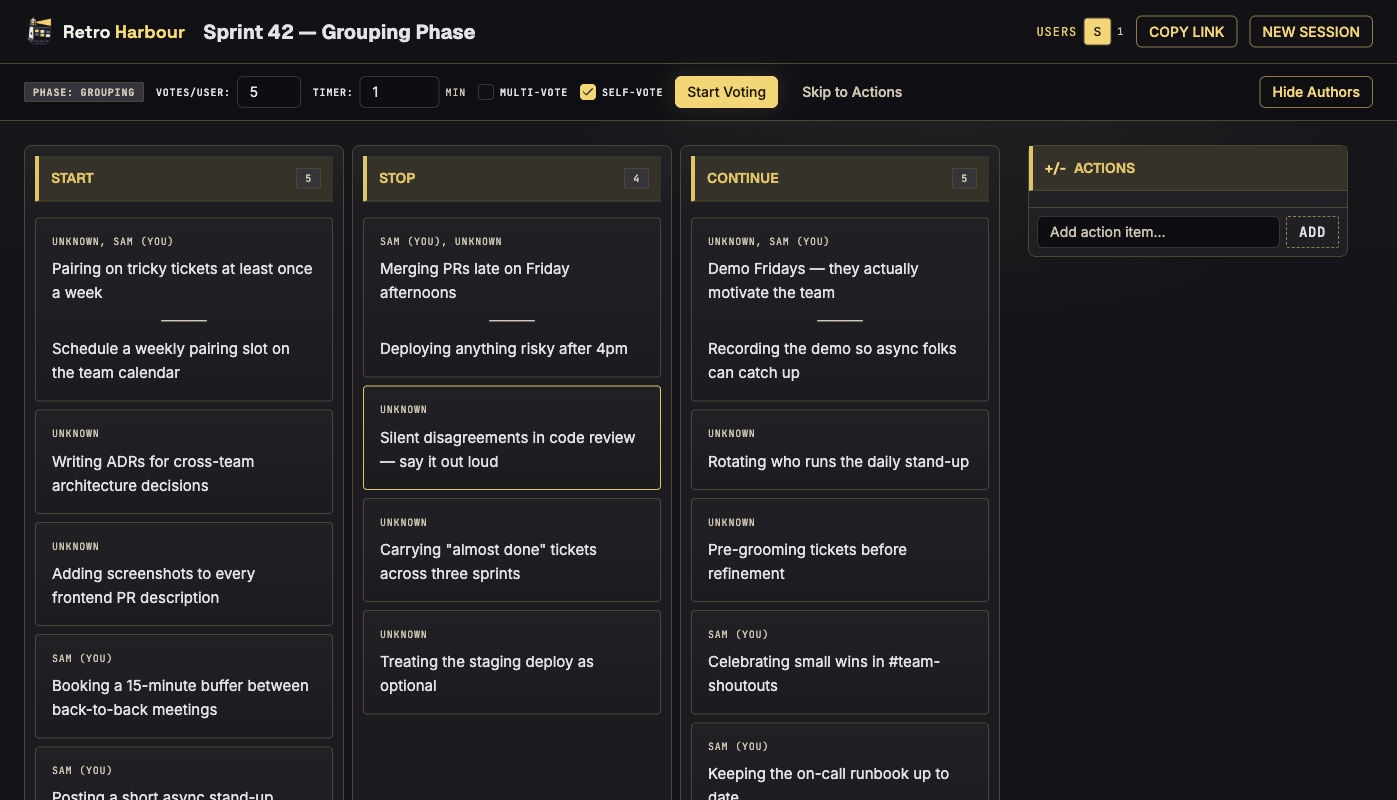
- Reveal and group (10 min). Flip the cards. Drag related ones together. A pattern usually surfaces fast - one repeating frustration often explains most of the "didn't" pile.
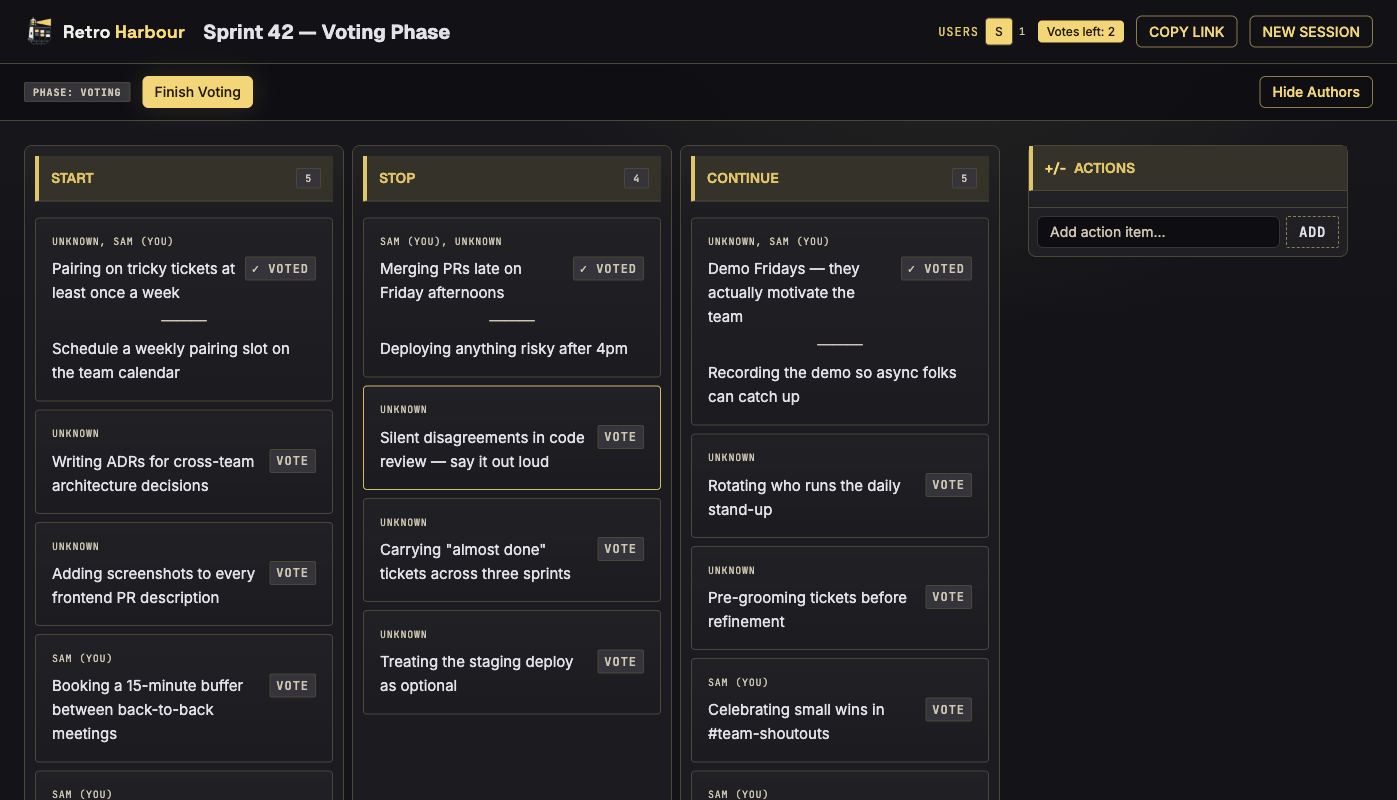
- Vote (5 min). Each person gets three dots. Spend them on the items worth discussing. The board re-sorts by votes.
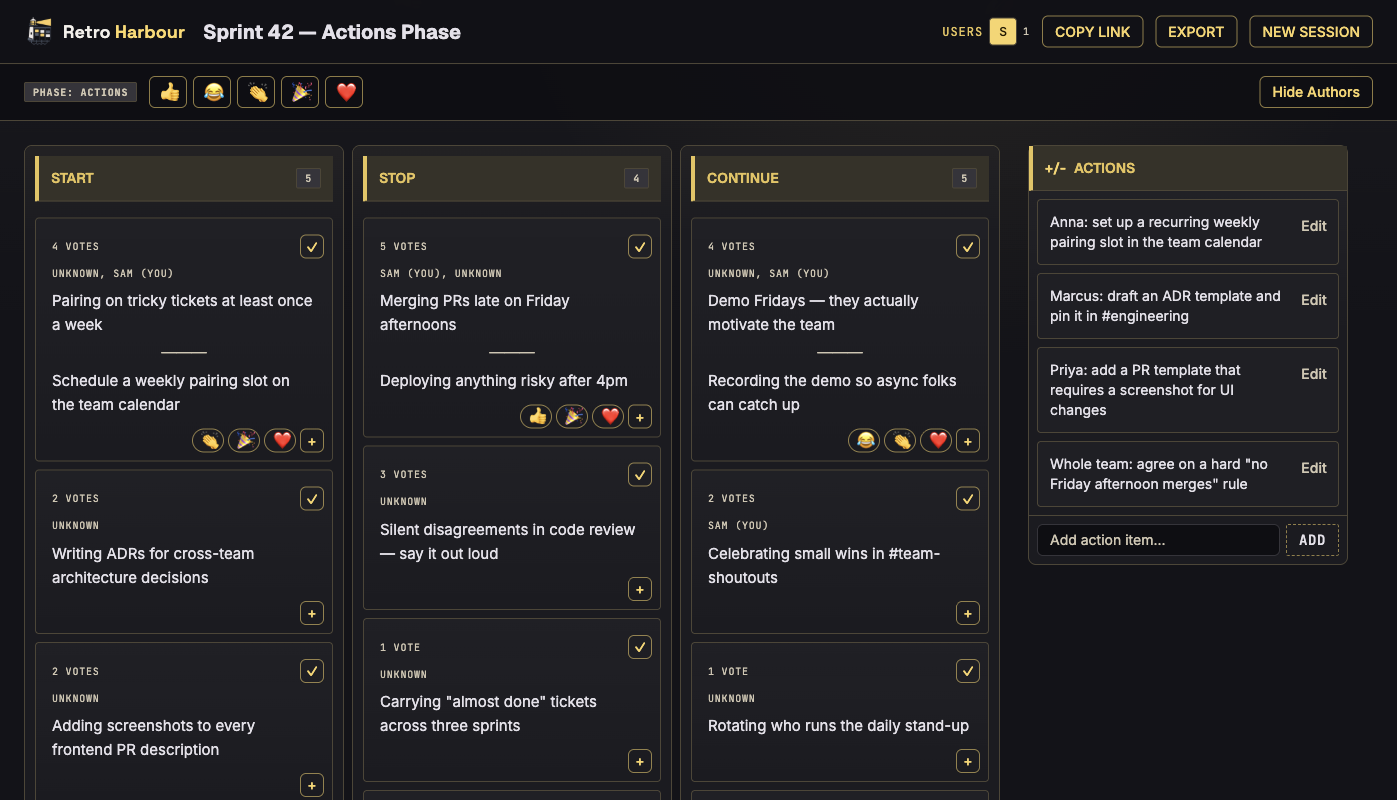
- Discuss and capture actions (15 to 20 min). Walk the top items. For each one, write an Action card with an owner and a date. Skip vague ones ("communicate better") in favour of things you'll know are done by next week.
- Export. One click drops the board into Markdown. Paste it into the wiki, the next sprint's ticket, or a thread in chat so the actions don't evaporate.
Prompts that get better answers
"What went well?" tends to surface generic praise. Sharpen the prompt and the cards get sharper too.
- Went well: What is one thing you'd want the team to do exactly the same next sprint?
- Went well: Which decision from this sprint paid off? Why?
- What didn't: Where did you lose the most time, and what caused it?
- What didn't: What slowed someone else down because of how we work?
- Action items: Pick the one change that, if it works, would make next sprint visibly better.
Tip: Commit to one action item, not five. Teams that ship one change per sprint and watch the result tend to improve faster than teams that promise a long list and forget half of it by Wednesday.
Template variants
Same shape, different prompts. Rotate variants every few sprints so the retro doesn't go on autopilot.
| Variant | Columns | Use when | Open |
|---|---|---|---|
| Went Well / To Improve / Action Items | 3 columns | Default sprint retro. Low friction, fast actions. | Open |
| Start / Stop / Continue | 3 columns: Start, Stop, Continue | Team needs to drop a habit, not just add one. | Open |
| 4Ls | 4 columns: Loved, Learned, Lacked, Longed For | Learning-focused sprint, onboarding, or after a research spike. | Open |
| Mad / Sad / Glad | 3 emotional columns | Sprint was rough; team needs to name feelings before fixing things. | Open |
| Sailboat | 4 columns: Wind, Anchor, Rocks, Island | Quarter or large initiative wrap-up; goals, risks, blockers in one board. | Open |
Example: a filled-in sprint retro
Here's what a healthy sprint retro looks like after the discussion. Wins are specific, pain points name a concrete event, and every action has an owner and a date.
What went well
×4 votes on the top item
What didn't
×5 votes on the top item
Action items
Owners attached, due before next planning
What the board looks like
The template runs inside Retro Harbour's real-time board. Same flow every sprint: write silently, reveal together, vote, capture actions, export.
Things this template won't fix on its own
A good template only goes so far. Most retros fail for reasons no format change can paper over.
- No owners on actions. "We should improve PR reviews" is not an action. "@sam clears the PR queue by Friday 5pm" is. If you skip the owner column, you'll run the same retro again next sprint.
- Same people doing all the talking. The silent-writing phase is there for a reason. If you skip it because "we know what to discuss", you'll miss the half of the team that doesn't interrupt.
- Stockpiling actions. Five new commitments per sprint compounds into a backlog of broken promises in two months. Pick one. Land it. Then pick the next.
- No follow-up. Open the previous retro at the start of the next one. If the action didn't happen, ask why before you let the team commit to new ones.
FAQ
What is the sprint retrospective template?
A pre-built board layout for the Scrum sprint retrospective. The default is three columns - What went well, What didn't, Action items - and the team uses it to reflect on the last sprint, vote on what to discuss, and commit to one or two concrete changes.
How long should it take?
45 to 60 minutes for a two-week sprint: 5 min setup, 10 min silent writing, 10 min grouping, 5 min voting, 15 to 20 min discussion and action capture. The Scrum Guide caps it at three hours for a one-month sprint.
Which template variant should I use?
Start with the 3-column default. Once the team is comfortable, rotate variants every few sprints to keep the conversation fresh - Start/Stop/Continue, 4Ls, Mad/Sad/Glad, Sailboat all use the same flow but ask different questions.
How many action items should we commit to?
One or two, with a named owner each. Long action lists are a reliable predictor that nothing on them will get done.
Can I customise the columns?
Yes. Rename them, add a Shout-outs column, or drop Action items if you're running a celebration retro after a launch. The template is a starting point, not a rule.
Does this work for remote and async teams?
Yes. Share the board URL, write silently, reveal together. For fully async retros, leave the board open for 24 to 48 hours and run the discussion in a thread instead of a call - see retrospective ideas for remote teams.
Is the template free?
Yes. Retro Harbour is free with no sign-up. Open the sprint retro template, share the link, and you're running.
Explore more formats in the retrospective templates guide — compare Start/Stop/Continue, 4Ls, Sailboat, and DAKI side by side.